By AUDREY McAVOY Associated Press
The Corporation for Public Broadcasting, which helps pay for PBS, NPR, 1,500 local radio and television stations as well as programs like “Sesame Street” and “Finding Your Roots,” said Friday that it would close after the U.S. government withdrew funding.
The organization told employees that most staff positions will end with the fiscal year on Sept. 30. A small transition team will stay until January to finish any remaining work.
The private, nonprofit corporation was founded in 1968 shortly after Congress authorized its formation. It now ends nearly six decades of fueling the production of renowned educational programming, cultural content and emergency alerts about natural disasters.
Here’s what to know:
Losing funding
President Donald Trump signed a bill on July 24 canceling about $1.1 billion that had been approved for public broadcasting. The White House says the public media system is politically biased and an unnecessary expense, and conservatives have particularly directed their ire at NPR and PBS.
Lawmakers with large rural constituencies voiced concern about what the cuts could mean for some local public stations in their state. They warned some stations will have to close.
The Senate Appropriations Committee on Thursday reinforced the policy change by excluding funding for the corporation for the first time in more than 50 years as part of a broader spending bill.
How it began
Congress passed legislation creating the body in 1967, several years after then-Federal Communications Commission Chairman Newton Minow described commercial television a “vast wasteland” and called for programming in the public interest.
The corporation doesn’t produce programming and it doesn’t own, operate or control any public broadcasting stations. The corporation, PBS, NPR are independent of each other as are local public television and radio stations.
Rural stations hit hard
Roughly 70% of the corporation’s money went directly to 330 PBS and 246 NPR stations across the country. The cuts are expected to weigh most heavily on smaller public media outlets away from big cities, and it’s likely some won’t survive. NPR’s president estimated as many as 80 NPR stations may close in the next year.
Mississippi Public Broadcasting has already decided to eliminate a streaming channel that airs children’s programming like “Caillou” and “Daniel Tiger’s Neighborhood” 24 hours a day.
Maine’s public media system is looking at a hit of $2.5 million, or about 12% of its budget, for the next fiscal year. The state’s rural residents rely heavily on public media for weather updates and disaster alerts.
In Kodiak, Alaska, KMXT estimated the cuts would slice 22% from its budget. Public radio stations in the sprawling, heavily rural state often provide not just news but alerts about natural disasters like tsunamis, landslides and volcanic eruptions.
From Big Bird to war documentaries
The first episode of “Sesame Street” aired in 1969. Child viewers, adults and guest stars alike were instantly hooked. Over the decades, characters from Big Bird to Cookie Monster and Elmo have become household favorites
Entertainer Carol Burnett appeared on that inaugural episode. She told The Associated Press she was a big fan.
“I would have done anything they wanted me to do,” she said. “I loved being exposed to all that goodness and humor.”
Sesame Street said in May it would also get some help from a Netflix streaming deal.
Harvard professor Henry Louis Gates Jr. started “Finding Your Roots” in 2006 under the title “African American Lives.” He invited prominent Black celebrities and traced their family trees into slavery. When the paper trail ran out, they would use DNA to see which ethnic group they were from in Africa. Challenged by a viewer to open the show to non-Black celebrities, Gates agreed and the series was renamed “Faces of America,” which had to be changed again after the name was taken.
The show is PBS’s most-watched program on linear TV and the most-streamed non-drama program. Season 10 reached nearly 18 million people across linear and digital platforms and also received its first Emmy nomination.
Grant money from the nonprofit has also funded lesser-known food, history, music and other shows created by stations across the country.
Documentarian Ken Burns, celebrated for creating the documentaries “The Civil War,” “Baseball” and “The Vietnam War”, told PBS NewsHour said the corporation accounted for about 20% of his films’ budgets. He said he would make it up but projects receiving 50% to 75% of their funding from the organization won’t.
Influence of shows
Children’s programing in the 1960s was made up of shows like “Captain Kangaroo,” ”Romper Room” and the violent skirmishes between “Tom & Jerry.” “Mr. Rogers’ Neighborhood” mostly taught social skills.
“Sesame Street” was designed by education professionals and child psychologists to help low-income and minority students aged 2-5 overcome some of the deficiencies they had when entering school. Social scientists had long noted white and higher income kids were often better prepared.
One of the most widely cited studies about the impact of “Sesame Street” compared households that got the show with those who didn’t. It found that the children exposed to “Sesame Street” were 14% more likely to be enrolled in the correct grade level for their age at middle and high school.
Over the years, “Finding Your Roots” showed Natalie Morales discovering she’s related to one of the legendary pirates of the Caribbean and former “Saturday Night Live” star Andy Samberg finding his biological grandmother and grandfather. It revealed that drag queen RuPaul and U.S. Sen. Cory Booker are cousins, as are actors Meryl Streep and Eva Longoria.
“The two subliminal messages of ‘Finding Your Roots,’ which are needed more urgently today than ever, is that what has made America great is that we’re a nation of immigrants,” Gates told the AP. “And secondly, at the level of the genome, despite our apparent physical differences, we’re 99.99% the same.”
News
Not just Big Bird: Things to know about the Corporation for Public Broadcasting and its funding cuts
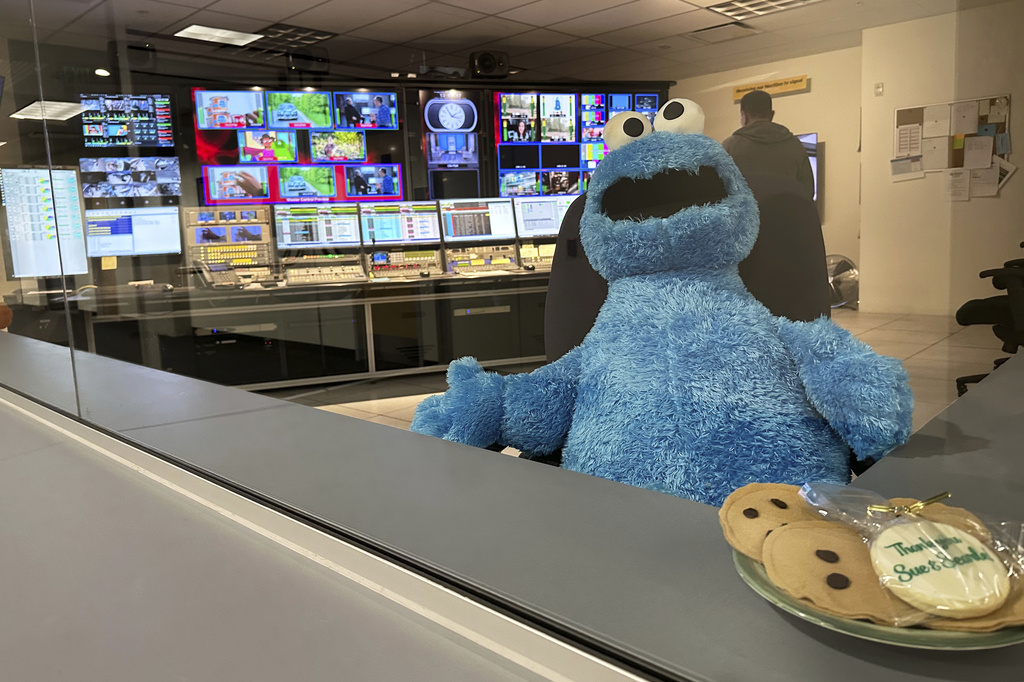
FILE - A stuffed Cookie Monster is seated in a control room at the Arizona PBS offices at the Walter Cronkite School of Journalism and Mass Communication in Phoenix, Friday, May 2, 2025. (AP Photo/Katie Oyan, File) Photo: Associated Press